
Right now, there is a manager somewhere, probably in a mid-sized tech company, whose calendar looks like abstract art. That manager is probably in charge of twelve people, running an AI integration project they weren’t hired for, and trying to remember the last time they had time to really talk to a junior employee. Gallup and the Bureau of Labor Statistics have found that the average American manager now has twelve direct reports, up from about six ten years ago. It wasn’t a mistake that they doubled. It happened because businesses thought the math behind using AI to cut costs looked great on a spreadsheet.
The office that combines humans and AI has arrived, and the corporate story about it is mostly positive. Less complicated levels. Decisions made faster. Not as many layers of red tape that slow things down. In theory, an AI system could handle scheduling, show performance alerts, summarize the weekly report, and point out the team member who is quietly pulling away from the work before anyone else notices. When you put it that way, the question is clear: why do you need so many managers? The answer, which is just now coming out in the data, is that the things AI can’t do are the same things that made management important in the first place.
According to Gartner, about one in five businesses plan to use AI to flatten their structure, which would mean getting rid of more than half of the middle management roles that are currently in place. Some businesses don’t wait for predictions to match up with reality. Meta’s applied AI engineering division is said to have a 50-to-1 employee-to-manager ratio, which would have been unthinkable even five years ago. It’s still not clear whether that will be used as an example or as a warning. Based on the industry you’re looking at, both things might happen at the same time.
The thing that gets lost when one person has twelve direct reports instead of six is harder to measure, which makes it easier to ignore in boardroom discussions. Coaching goes away first. It’s not that managers don’t care; it’s just that time is limited and is given to the person who needs it the most, not the person who seems most promising. When bandwidth drops, relationships like that of a first-year worker trying to figure out how to handle a tough conversation with a stakeholder or a mid-level analyst who needs someone to speak up for them during a promotion discussion get lost. A recent Gartner survey found that one-third of HR leaders said that AI-driven restructuring had taken away institutional knowledge that the remaining workforce could not replace.
A study frame from MIT economist Neil Thompson helps to make sense of some of this noise. His research shows that which part of a job AI automates is more important than whether it automates any part of it. If automation gets rid of the administrative support for a role but doesn’t change the expert work, wages tend to go up and the profession gets stronger. Geoffrey Hinton said in 2016 that AI would replace radiologists within five years. The radiologist is the best example of this. Instead, they learned how to use the tools, read more scans more accurately, and got more work and more money. The technology changed the role instead of getting rid of it. Managers want to know if they’re living the same story or a completely different one.
Perhaps for the time being, there is a reason to doubt the positive version. According to a survey by Gartner, 75% of HR leaders think managers are already too busy with all of their new duties, and 69% say managers don’t have the skills to lead change well, even before AI is fully integrated. Global employee engagement has dropped to 21%, which is close to the lowest level seen in 15 years.
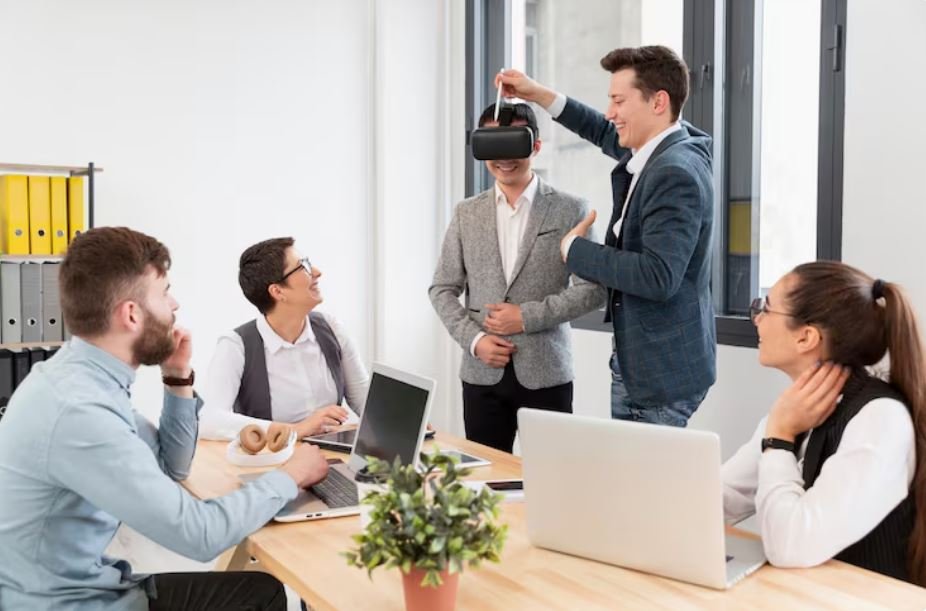
The biggest drops are happening not just among regular workers but also among managers. The Wall Street Journal recently said that many offices are starting to smell like graveyards. That’s a powerful word, and anyone who has been paying attention to knowledge work over the last two years can agree that it fits.
All of this doesn’t mean that the change can’t be undone or that the hybrid office is a bad way to run a business. Morgan Stanley economists looked at five previous waves of innovation in the United States, from the first Industrial Revolution to the internet. They found a pattern: productivity gains happen in the end, workers are re-assigned instead of being made permanently obsolete, and the economy grows. But the times of change were hard, and how the gains were shared depended a lot on policy choices and how institutions responded. In the past, the pain came before the benefit. That’s where it looks like most middle managers are right now: paying for the changes while they wait for the promised payoff that hasn’t come yet.
It’s hard not to see the irony in this whole thing. At least in its current form, the technology that was supposed to make management easier has made it harder, more lonely, and more important all at the same time. The people whose job it is to keep teams together during one of the most upsetting changes in the workplace in a generation are quietly being taken away from the help, time, and structural breathing room they need to do their jobs well. It’s not a problem with the technology. It’s a problem with priorities. It also means that the hybrid human-AI office will eventually become stable, but the version that is being built now isn’t built on a base that is strong enough to hold.
