


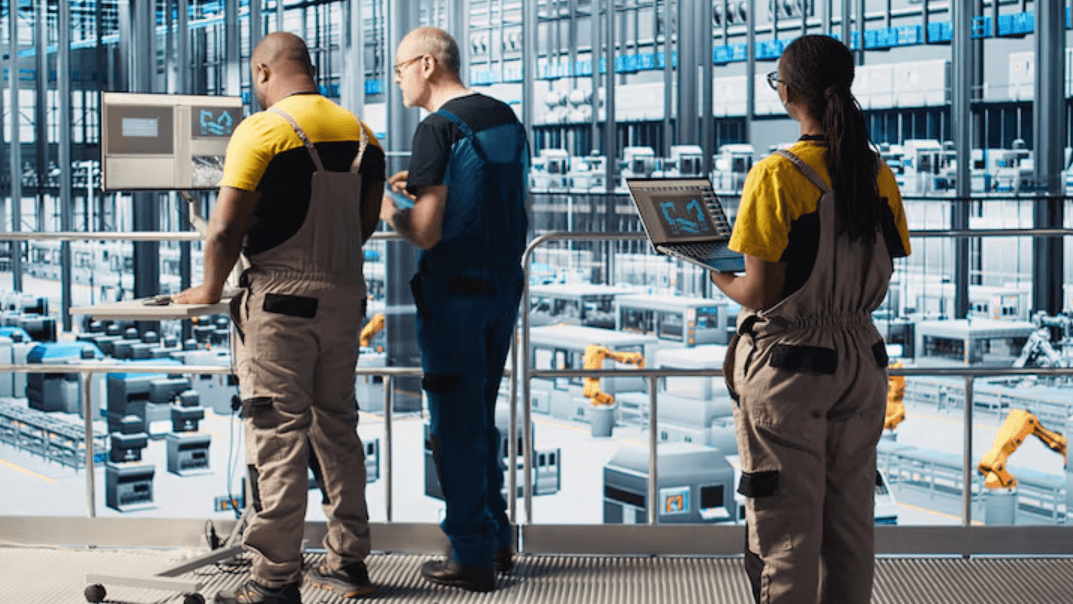
There’s a good chance you’re witnessing the next stage of the AI gold rush if you stroll through practically any mid-sized American town and notice a patch of cleared land with a thicket of cranes rising on its edge. Not a campus for software. It’s not a tech park with free cold brew and glass walls. A data center is a structure that appears almost unremarkable from the outside, but on the inside, it is one of the most intricate electrical construction projects a skilled tradesperson will ever work on.
It’s becoming difficult to ignore the numbers. Data center construction workers are earning between 25 and 30 percent more than comparable commercial builds. Experienced electricians are reporting salaries well over $100,000; these are the ones who can manage medium-voltage power systems and comprehend the unique requirements of AI infrastructure. Labor data circulating among hiring firms indicates that certain roles pay significantly more. A college degree is completely optional, but it’s possible that a licensed electrician with commissioning experience is now among the better-paid workers in American construction.
Businesses’ desire for more data centers isn’t the only factor causing this. The reason for this is that the centers they are currently constructing are essentially different from those that came before. Five years ago, the amount of power needed for a facility intended to run generative AI workloads would have seemed unthinkable. Advanced electrical distribution, fiber infrastructure, liquid cooling systems, and backup power validation all require experts rather than generalists. A typical commercial crew from a hotel project cannot be dropped into this setting. There are strict tolerances, a specialized skill set, and serious repercussions for commissioning errors.
Speaking with labor economists and contractors who monitor this market, it seems that the demand has simply outpaced the supply of labor, which is beginning to cause significant friction. In just six months, from late 2025 to early 2026, the number of job postings worldwide for construction positions that specifically mentioned data centers increased by 23%. By the end of 2026, workforce researchers estimate that there may be a labor shortage of nearly 500,000 people. The possibility of a billion-dollar project coming to a standstill due to a shortage of commissioning experts in the area is real; contractors are already handling it covertly.
In late 2025, Jensen Huang stated unequivocally that what the AI industry is planning will require hundreds of thousands of plumbers and electricians. In more direct terms, BlackRock’s Larry Fink informed White House officials that the decline in trade school enrollment and the deportations of immigrant workers were pointing to a very particular issue. Whether the policy response will be quick enough to matter for projects that need to start construction right away is still up in the air.
In certain aspects, what’s happening on the ground resembles previous resource booms. workers moving from one project to another. temporary housing in places that weren’t designed to handle unexpected increases in population. Due to the higher wages and more stable work, workers from the oil fields and industrial construction industry are migrating to data centers. A specific type of labor migration is taking place in the United States, and it is almost solely caused by the fact that tech companies require buildings with high power consumption and quick internet access.
The subtle irony that permeates everything is difficult to ignore. Some of the most long-lasting short-term job opportunities for manual laborers are being created by businesses investing in artificial intelligence, a technology that is frequently discussed as a threat to white-collar employment. Your LinkedIn profile is irrelevant to the 250,000-square-foot facility that is being built outside of Indianapolis. Someone who can test a backup generator under load at two in the morning and do it correctly the first time is needed.
It’s truly unclear if this moment will endure for another two or ten years. The fact that a licensed electrician with data center experience is currently holding something valuable during this particular window appears less uncertain.
