
The way this transpired was almost inevitable. A law was passed in Philadelphia. The federal government filed a lawsuit. Before it could take effect, a judge appointed by Trump blocked it. The entire process took place in a few weeks, and by Thursday, July 3, the city’s most aggressive anti-ICE law was essentially on hold.
U.S. District Judge Chad Kenney issued a preliminary injunction blocking Philadelphia from enforcing a bill that would have required federal immigration agents to remove their masks, display visible badges, and use marked vehicles while operating in the city. The law was part of a seven-bill “ICE Out” package passed by Philadelphia City Council earlier this year — a package designed to push back against what many in the city called violent and opaque immigration enforcement operations.
Kenney didn’t hold back. Citing the Supremacy Clause, which gives federal law precedence over state and local laws, he wrote that Philadelphia’s attempt to control how federal agents carry out their duties was “blatantly impermissible.” The Trump administration has been using this legal defense in comparable disputes across the nation, and thus far, it has been successful.
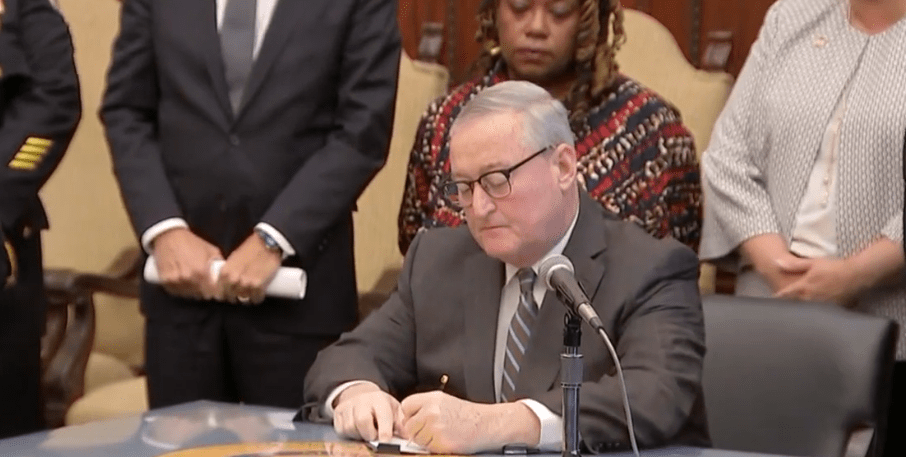
What makes this case a little unusual is the role Mayor Cherelle Parker played — or rather, didn’t play. Citing doubts raised by the city solicitor regarding the city’s legal authority to regulate federal officers, she refused to sign the mask bill. She did not, however, veto it either. She let it become law without her name on it, a kind of civic hedge that Kenney, somewhat surprisingly, chose to praise rather than condemn. He described her behavior as an illustration of “civic wisdom and courage.” Although it’s a strange compliment to give someone who essentially stood aside, it shows how the judge understood the current political climate.
On June 18, the Justice Department filed a lawsuit against Philadelphia, claiming that the law penalized federal agents both civilly and criminally for carrying out their federally mandated duties. Additionally, the administration contended that compelling agents to divulge their identities could jeopardize undercover operations and put them in danger in the field. Philadelphia’s attorneys retorted that undercover operations and surveillance were exempt from the law. At this point, at least, Kenney was not convinced.
It’s worth taking a step back to observe how familiar this is getting. A few days prior, a similar masking restriction was overturned by a federal judge in Virginia. California’s version was halted months ago. In New Jersey, the DOJ is still awaiting a decision. There’s a pattern here: states and cities are making rapid progress, but federal courts are stopping them. Whether that pattern holds through appeal is a different question, and the legal fights are far from finished.
The bill’s co-sponsor, Councilmember Kendra Brooks, described the decision as a “bad decision” and noted that cases are still pending in other courts. She’s right to point that out. Constitutional law is not resolved by a single preliminary injunction. However, it does convey a message, which is currently fairly obvious: local governments have little authority to control how federal agencies operate.
The other six bills in the ICE Out package — the ones Parker actually signed — are still set to take effect July 7th. Those cover data sharing, anti-discrimination protections, and restrictions on ICE’s use of city-owned property. That is not insignificant. However, the most direct conflict was the mask law, which was defeated.
There’s a broader tension here that won’t go away simply because a judge ruled. Residents of Philadelphia have genuine and justifiable concerns about accountability because many of them have witnessed masked federal agents make arrests in their neighborhoods without showing any identification. The legislation attempted to address those issues. Whether there’s a version of that effort that survives constitutional scrutiny is still an open question — one that courts across the country are slowly, unevenly, beginning to answer.
