
When it comes to education, Korea has a remarkable story to tell. Most nations are envious of the rate at which its universities produce engineers. Some of the world’s most cutting-edge semiconductor and biotechnology companies use its corporate research labs. This is a nation that values human capital by nearly all traditional standards. However, when the QS World Future Skills Index 2027 was released last month, one figure stood out in an unsettling way: 36th in terms of the penetration of AI skills in the larger labor market.
Overall, sixth in the world. The skill that is expected to define the next ten years of work is ranked 36th. It’s difficult to compare those two figures without sensing that something structural is amiss.
The term “future skills paradox,” which QS used, is more appropriate than most buzzwords. In STEM, Korea’s higher education system is truly outstanding. Its corporate R&D intensity is real. But QS’s index measures something different from raw academic output — it asks whether the skills being produced are actually flowing into the labor market at scale. And on that question, Korea ranks 15th in the “future of work” sub-category, slipping noticeably behind economies it routinely outperforms on traditional education metrics.
The explanation, once you start looking, is less surprising than the headline suggests. Rigidity is a well-known issue in Korea’s labor market. With very little in between, a generation of graduates is either directed toward chaebol jobs or left to navigate unstable non-regular employment. That structure doesn’t naturally absorb or reward diffuse AI skill-building across industries. The prestige economy — where the credential matters more than the competency — tends to produce workers who are very good at passing through narrow gates, and less practiced at adapting when the gates move.
There’s also a more immediate problem sitting inside the school system itself. Despite Korea’s stellar international reputation, the country’s classrooms are actually having a hard time preparing students for a future shaped by artificial intelligence. Beginning in 2025, the Education Ministry made coding a required subject in middle schools. However, as of September of last year, there were only nine universities in the nation with computer education departments, and they all admitted fewer than 200 students annually. One IT instructor is frequently rotated among up to ten campuses. The used textbooks were written prior to the development of ChatGPT.
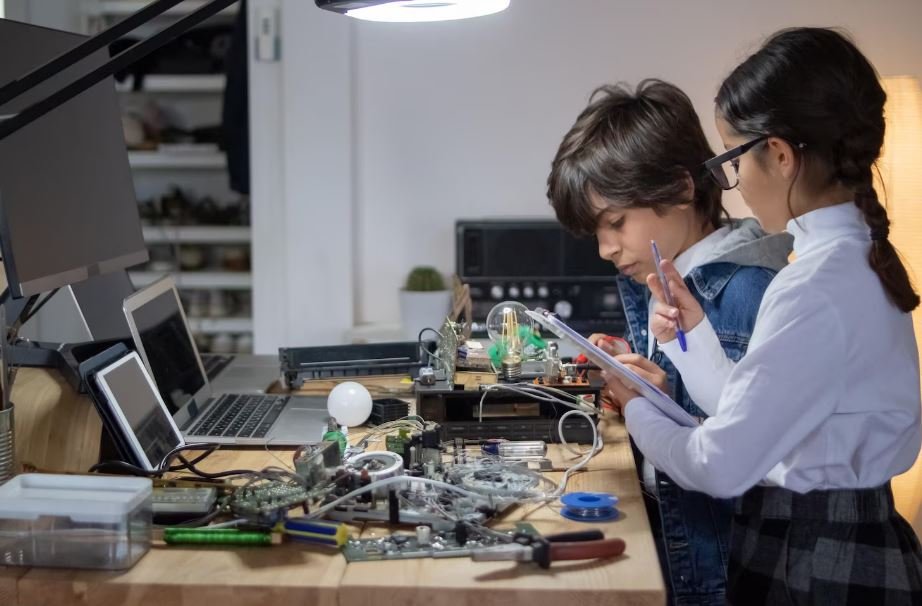
One high school teacher in Seoul’s Mapo-gu described the situation bluntly: students are asking why they don’t learn about generative AI in class, and teachers are building their own materials because the curriculum doesn’t cover it. That gap — between what’s happening in the world and what’s being taught in the room — is probably widening faster than any ministry can close it through budget cycles and policy revision. Over the course of six elementary school years, Korea allots about 34 hours of computer instruction. 374 hours are allotted by Britain. Japan allots 405.
It’s possible that the government’s current AI literacy program, which is expected to bring in close to $1 billion a year and is purportedly financed by a tax increase on financial and insurance companies, will begin to change things. It’s also possible that money isn’t the deeper issue. For many years, South Korea has made significant investments in education. The paradox it finds itself in today wasn’t produced by underinvestment. It was produced by a system that optimized for the wrong outcomes: credentials over adaptability, institutional prestige over distributed skill development, elite pipeline over broad workforce readiness.
There’s a sense that Korea understands this. The QS report is being discussed rather than ignored. The Glocal and RISE reform initiatives specifically seek to shift academic funding and prestige away from Seoul, indicating some awareness that concentration is a contributing factor. It’s another matter entirely whether those reforms proceed quickly enough to have an impact on current workers.
The 36th-place ranking in AI skills penetration isn’t a verdict on Korean intelligence or ambition. It indicates where those attributes are currently being directed and whether the systems intended to foster them are still aimed in the right direction.
