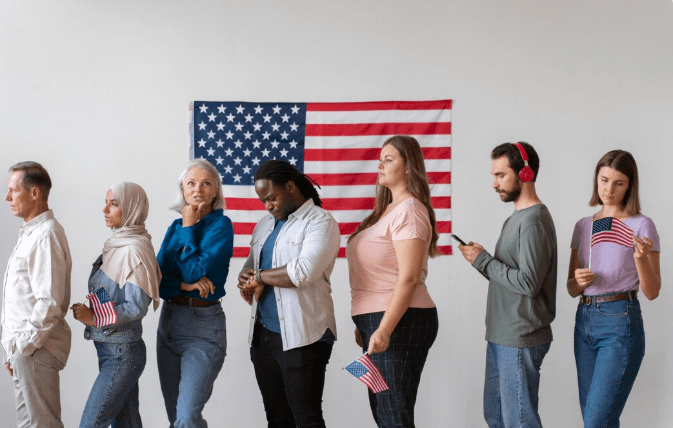
On a Tuesday morning, if you stroll through any major American city, you’ll notice something that isn’t always discussed during policy discussions or earnings calls. Twenty years later, the workforce entering restaurants, offices, hospitals, and warehouses is very different. It is older in some places and younger in others. More varied in both quantifiable and non-quantifiable ways. The data supports what everyday observations already point to: the American workforce is undergoing rapid change.
In January 2025, the number of civilian workers in the US surpassed a record 170.7 million. That number is significant on its own. Decades of population growth, immigration trends, changes in education, and the gradual but steady recovery from the economic disruptions caused by the pandemic are all reflected in it. Currently, about 62% of people of working age are employed; while this percentage may seem steady, there is a lot of tension beneath it.
One of the most obvious demographic differences in the workforce is still gender. Men continue to participate at a higher rate than women, averaging about 67% versus 57%. However, that difference has been closing for decades, and it is fairly obvious where things are going. Approximately 47% of workers are women today. The Equal Pay Act of 1963, the Civil Rights Act of 1964, and a number of generational attitude shifts that subtly rewrote expectations about who works and in what capacity all contributed to that shift. It’s difficult to ignore how much ground has been covered, even though there is still a gap.
It is worthwhile to consider how race and ethnicity influence the workforce. At about 63%, white non-Hispanic workers continue to make up the majority. Roughly 19% of workers are Hispanic or Latino, and this percentage is rising more quickly than that of any other demographic group. Asian workers make up about 7% of the labor force, while Black workers make up about 13%. These statistics go beyond demographics. They have an impact on wage parity, industry representation, and who gets promoted and who doesn’t—issues that businesses and legislators are still figuring out, frequently inadequately.
An additional level of complexity is introduced by the generational divide. At about 45% of the workforce, millennials, who are currently in their late twenties to early forties, make up the largest cohort. In a way that their employers don’t always comprehend, they were shaped by economic precarity when they entered the market during or shortly after the 2008 financial crisis (external site). Workers under the age of 24, or Gen Z, make up around 11% of the workforce and are still coming in greater numbers. About 24 percent of working Americans are Baby Boomers, many of whom postponed retirement following the 2008 recession and the financial disruptions caused by COVID. Some people are opting for gig work. Some people just cannot afford to give up.
The workforce is still being reorganized from within by education. Today, about 40% of workers have a bachelor’s degree or above, an increase of 12 percentage points since 2000. This change affects the industries that expand, the high-paying jobs, and the areas where economic mobility is truly feasible. However, roughly 7% of the workforce lacks a high school degree, and those individuals are typically found in the lowest-paying, most physically taxing jobs. The disparity between those with and without credentials isn’t closing quickly enough to cease to be an issue.
Over the next ten years, it’s still unclear how these demographic trends will interact with automation, AI adoption, and the ongoing restructuring of major industries. It seems reasonable to assume that the workforce of 2035 will differ significantly from that of today; it will be, on average, older, more Hispanic and Latino, have higher levels of formal education, and be navigating a labor market that is constantly changing its own regulations. Those who arrive at work each morning are already experiencing that shift. The information is only now catching up.