
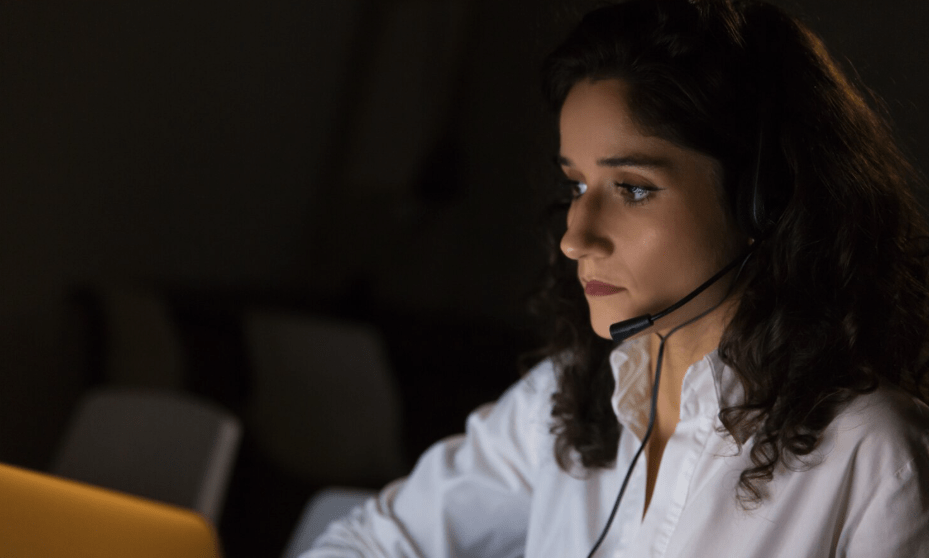
Sitting at your kitchen table with a cold cup of coffee next to you and knowing that every keystroke you make is being recorded, timestamped, and examined by software you never requested to have installed is a subtly unsettling experience. This is a real situation for millions of remote customer service representatives. Tuesday morning.
Just 10% of businesses with remote employees used any kind of monitoring technology prior to the pandemic. After three years, that figure had nearly completely changed. When working remotely, surveillance has become the norm rather than the exception. Mouse click counts, idle time flags, keystroke logs that run silently in the background, and screen captures that fire every 20 minutes. Employees who exchanged their commutes for home offices were not entirely aware of what they were giving up.
The sharpest edge of this is found in customer service positions. Managing irate callers, bearing emotional burdens, and meeting response time goals while maintaining composure are just a few of the challenging aspects of the job that don’t neatly appear in performance dashboards. When you add aggressive monitoring software on top of that, pressure builds in ways that are difficult to describe but simple to sense. It is plausible that a large number of employers sincerely think they are evaluating performance. In reality, they might be measuring anxiety.
A manager may be able to determine whether an employee is working or watching Netflix using the information gathered from keystroke logging and app tracking. In reality, it frequently fails to distinguish between someone who took a moment to consider a challenging customer issue and someone who completely moved away. According to a ResumeBuilder.com survey of one in three businesses, employees spend an average of three hours a day on non-work-related activities, a statistic that businesses characterize as “time theft.” However, that framing ignores the more intriguing question of why they are initially disengaging.
Nearly 70% of businesses admitted that concerns about monitoring were a specific reason for employee resignations. Approximately 35% of those reported losing six to ten employees in this manner. Stacie Haller, a career advisor at ResumeBuilder.com, put it plainly: firing workers who have been identified as unproductive while also losing high-performing employees who just don’t want to be watched doesn’t seem like a win. Even before you take into consideration the expenses of hiring new employees and the loss of institutional knowledge, the math isn’t quite right.
This has a generational component that is underappreciated. People who developed their management instincts in open-plan offices, where visibility meant accountability, make up a large portion of the managers who pushed hardest for monitoring tools. The visual cues they depended on, such as the person at the desk and the body language across the table, were eliminated when they worked remotely, and surveillance software took their place. It’s still unclear if these managers actually think the software increases team productivity or if it just makes them feel less uneasy.
The psychological impact of ongoing surveillance appears to point in one direction, particularly for customer service representatives. Employees who work remotely are typically more productive than those who work in offices, according to numerous studies. They take fewer sick days and put in more hours at work. Those figures don’t seem to be improved by surveillance. It does appear to increase stress levels, erode trust, and encourage people to engage in a form of performance theater where they appear busy rather than productive.
As this develops, it seems that the remote work experiment revealed more about management culture than it did about employee discipline. In many cases, businesses that implemented monitoring tools on a large scale did so because they had no other option. The reliance on keystroke logging and screenshot captures may gradually wane as younger managers—people who grew up working remotely and never needed to see someone sitting at a desk to believe they were doing their job—ascend. Or it may not. Both the software and the habits are already ingrained.
